

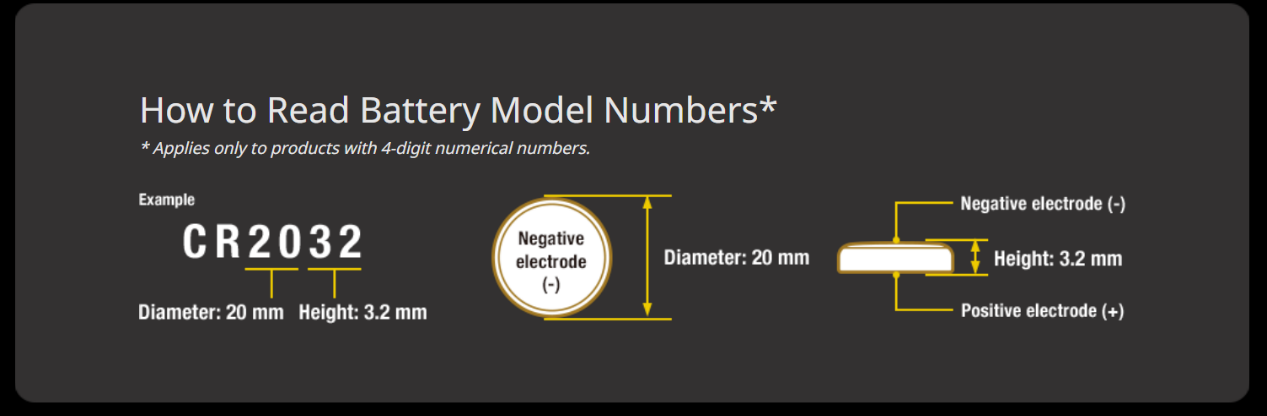
Lithium: It means that the negative electrode material of the battery is metallic lithium, which gives the battery the characteristics of high voltage, high energy density and long life. Manganese: It means that the cathode material of the battery is manganese dioxide. Button: Describing the battery shaped like a small button, usually round and flat. CR: This is the most common model prefix for this type of battery. C represents a chemical system with lithium as the negative electrode. R represents that the shape of the battery is circular. The following numbers represent the size code of the battery, such as CR2032, CR2025, CR1632, etc.
The rated voltage is 3.0V or 3.2V (open circuit voltage), which is more than twice that of ordinary alkaline batteries (1.5V) or nickel-hydrogen rechargeable batteries (1.2V).
At the same size, it can store more electricity, so its battery life is very long.
The voltage can remain very stable throughout its service life and will not gradually drop like some batteries. When the battery is running out, the voltage will suddenly drop.
The self-discharge rate is extremely low. The annual self-discharge rate at room temperature is usually less than 1-2%. It can be stored for more than 10 years while still retaining most of the electricity.
It can operate normally within a wide temperature range from-40 ° C to +85 ° C or even more, and performance is less affected by temperature.
Strong structure and not easy to leak. In contrast, alkaline button batteries are more likely to leak and damage the equipment.
Lithium metal is very light, making the overall weight of the battery lighter.
◆ Negative electrode: Made of metallic lithium, located on the upper cover of the battery (usually the negative electrode).◆ Positive electrode: It is made of mixed pressing manganese dioxide and conductive agent and is located on the bottom shell of the battery (usually the positive electrode).◆ Diaphragm: A porous film placed between the positive and negative electrodes to allow ions to pass through but prevent electrons from conducting directly and avoid short circuits.◆ Electroliquid: An organic electrolyte containing lithium salt is responsible for conducting ions inside the battery.◆ Principle: During discharge, lithium atoms lose electrons at the negative electrode and turn into lithium ions. The lithium ions move to the positive electrode through the electrolyte and separator and react with manganese dioxide. Electrons flow to the positive pole through an external circuit (your device), creating current.

◆ Not rechargeable!: Lithium-manganese batteries are primary batteries. You must never try to charge them, otherwise it will cause gas generation, heat, and even explosion or fire inside the battery, which is very dangerous!◆ Correct installation: Pay attention to the positive and negative electrodes during installation. If the equipment is installed upside down, it will not work.◆ Avoid short circuits: Do not mix batteries with metal objects (such as keys, coins). Connecting the positive and negative electrodes with metal will cause instantaneous high current discharge, which is very dangerous.◆ Discard: Recycling should be carried out in accordance with local regulations and should not be discarded at will.◆ Prevent children from swallowing by mistake: The size of button batteries is easy to be swallowed by children. Once stuck in the esophagus, the battery will discharge and quickly burn the tissue, causing serious injury or even death. Keep out of reach of children.◆ Prohibition of mixing: old and new, different models or brands of batteries should not be mixed.◆ It is forbidden to modify without permission: the heat of welding the battery may destroy the sealing performance of the battery or short-circuit the battery internally, causing leakage, fire or explosion. Long-term use of welded batteries may damage equipment.


| expected service | test name | discharge state | test sample size | EC clause | requirements | test method |
|---|---|---|---|---|---|---|
| A/B/C/D (use the same battery, sequence it in turn) | ||||||
| A | altitude simulation | 10 fully discharged 8/10 did not discharge | 6.4.2 | 6.4.3 N, IV, NC, NR, NE, NF during testing | The tested cell was placed in an environment with a pressure of 11.8Pa or a lower temperature of 20±5℃ for 6 hours. | |
| B | temperature cycling | 10 fully discharged 8/10 did not discharge | 6.4.2 | 6.4.3 N, IV, NC, NR, NE, NF during testing | The tested cell is first stored at a test measurement level equal to 72℃ for at least 6 hours, and then stored at a test measurement level equal to 40℃ for at least 6 hours. The maximum time interval between two extreme test measurements is 30 minutes. The procedure was repeated 10 times, and then all test cells and batteries were stored at ambient temperature (20±5℃) for 24 hours. | |
| C | vibration | 10 fully discharged 8/10 did not discharge | 6.4.2 | 6.4.3 N, IV, NC, NR, NE, NF during testing | The tested cell should experience a simple resonance with an amplitude of 0.8mm (maximum displacement of 1.6mm). The frequency changes at a rate of 1Hz/min. within the range of 10Hz to 55Hz. Recovery occurred after 30 minutes to 100 minutes. This vibration cycle should be repeated 12 times in each of three fixed orientations perpendicular to each other. The total duration for each position is 3 hours. The cells and batteries should have no leakage, no leakage, no short circuit, no rupture, no explosion, and no fire. | |
| D | Shock | 10 fully discharged 8/10 did not discharge | 6.4.2 | 6.4.3 N, IV, NC, NR, NE, NF during testing | The tested cells are fastened to the testing device with a rigid bracket that supports all mounting surfaces of each tested cell. Each cell must withstand a half-sine wave impact with a maximum acceleration of 150m and a pulse time of 6 ms. Each cell must withstand three shocks in the positive direction of three mutually perpendicular cell installation orientations. Then he suffered three shocks in the opposite direction. It suffered a total of 18 shocks. | |
| E-K (using samples tested by A-D) | ||||||
| E | external short circuit | 10 fully discharged 8/10 did not discharge | 6.5.3 | NT, NR, NE, NF during the test and 6-hour post-test observation period | Stabilize the temperature of the battery cell to be tested so that its shell temperature reaches 55℃. The battery discharge battery was then subjected to a short circuit condition at 55 ° C with a total external resistance of less than 0.1Ω. This short circuit condition should last for at least 1 hour after the temperature of the cell or battery pack shell returns to 55 ° C. | |
| G | extrusion | 5 were not discharged | 6.5.3 | NT, NE, NF during the test and 6-hour post-test observation period | Place the battery cell between two planes and squeeze it, and the squeezing force gradually increases. The velocity at the first contact point is approximately 1.5 cm/s. Pressing continues until one of the following three conditions occurs, and the pressure can be relieved: a) the applied force reaches 13kN± 0.78 kN;b) the battery voltage drops by 100mV or more | |
| H | forced discharge | 10 fully discharged | 6.5.4 | NE, NF during the test and 7-day post-test observation period | Each cell should be forcibly discharged in series with a 12V DC power supply at ambient temperature at an initial current equal to the maximum discharge current for manufacturing high energy. A resistive load of appropriate size and rating is connected in series with the test battery to calculate the given discharge current. Each battery is forcibly discharged, and the discharge time should be equal to its rated capacity divided by the initial test current. | |
| I | exceptional charge | 5 were not discharged | 6.5.5 | NE, NF during test | Each cell is connected to a DC power supply in reverse and subjected to 3 hours of current charging. Test time: d=50h | |
| J | free fall drop | 5 were not discharged | 6.5.6 | NV, NE, NF during the test and 1 hour post-test observation period | The battery cells that have not been spared are dropped on the concrete surface from a height of 1m. Each battery under test should be dropped 6 times, and the polarity should be marked with the size of the battery once, that is, the battery should be placed twice in three axes, and then the battery under test should be placed for 1 hour. | |
| K | thermal abuse | 5 were not discharged | 6.5.7 | NE, NF during test | Put the battery cell into the test chamber, and the test chamber heats up at a temperature rise rate of 5 ° C/min. When the temperature in the chamber reaches 130 ° C, keep the temperature at the same temperature and keep it for 10 minutes. | |
Note:The test items in the table are grouped according to expected use. A-D are tested in turn using the same battery, and E-K use samples tested in A-D.
IEC60086-1: Primary batteries Part 1: General
IEC60086 -2: Primary batteries-Part 2: External size and electrical properties
IEC60086-4: Primary batteries Part 4: Safety performance of lithium batteries
3V lithium-manganese button batteries are lithium metal batteries (groups)-please comply with the following regulations when transporting to ensure compliance and safety.
| modes of transport | Category | United Nations Number (UN No.) | Classification of dangerous goods | packaging requirements | Individual weight limit | special provisions |
|---|---|---|---|---|---|---|
| Air transport | transported separately | UN 3090 | Category 9 Miscellaneous dangerous goods (lithium metal batteries) | The packaging instructions of IATA PI 968 Part IB must be strictly followed. | The net weight of each package (including batteries) shall not exceed 2.5 kg | Air Transport Qualification Report |
| shipping | UN 3090 (under SP188) | If it complies with the special clauses of SP188, it may not be transported as dangerous goods. | There are no mandatory packaging requirements for dangerous goods, but the packaging must be firm to prevent short circuits and accidental start-ups. | There are no special single net weight limits, but regular cargo weight regulations must be followed. | Shipping appraisal report |
To ensure transportation compliance and safety, please note the following points:
① Lithium battery UN3090 logo must be on the packaging box
② The minimum font size for UN coding is 12mm high
③ The width of the red border is 5mm
④ Logo size (width × height): 100mm × 100mm, minimum: 100mm × 70mm (old and new labels can be used at the same time before December 31, 2026)
Air freight is always strictly operated as Class 9 dangerous goods; there is an exemption route (SP188) for sea freight, but it is necessary to proactively declare to the carrier and confirm whether all conditions are met.
Insulation and protection against short circuits: The batteries must be individually insulated (e.g., with plastic bags) to ensure that the electrodes do not come into contact with any metal or other batteries.
Solid filling: Use a lining (such as foam) to secure the battery to prevent it from moving within the box during transportation.
Strength of outer box: The outer packaging box should be strong, anti-damage, and able to withstand stacking and handling.
Prepare necessary documents such as MSDS (Material Safety Data Sheets) and identification certificates in advance.
Always communicate with the carrier (shipping company, airline or freight forwarder) in advance to ensure that their requirements are met.






 Su Public Network Security File No. 32040002010632